Professor Alex Sanmark and Dr Oisin Plumb Major New Publication Now on Pre-Order
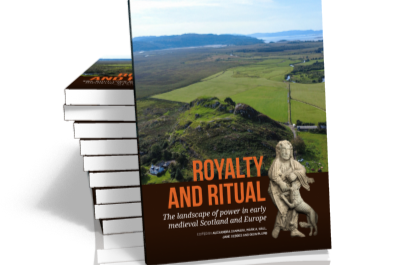
'Royalty and Ritual: The Landscape of Power in Early Medieval Scotland and Europe' edited by Professor Alex Sanmark (UHI Institute for Northern Studies), Dr Mark Hall, Professor Jane Geddes and Dr Oisin Plumb (UHI INS) is now available for pre-order from Sidestone Press
In recent years, there has been a growing interest in royal sites in Scotland, as well as in other parts of Europe, including Ireland, Scandinavia, the Slavic kingdoms and the Carolingian Empire. It has been shown that sites of royal settlement, ritual and assembly are frequently located at nodal communication points in the landscape , and that they often have a long biography evidenced by archaeological remains going back into the Iron Age or earlier. Often these nodal locations are also physically , such as by water or in elevated settings. ‘The Northern Picts’ project has explored some of these issues for Northern Scotland through excavations at e.g. Rhynie and Burghead.
Archaeologically, the question of ritual in early medieval Scotland has been under-explored. Early medieval royal sites in Scotland are strongly associated with kingship and inauguration rituals, but the nature of these rituals has not been fully examined. This project has addressed this aspect through detailed study of written sources and archaeological remains, as well as drawing on knowledge from other parts of Europe where this theme has been more fully researched. Different types of ritual, their purpose, and meaning to the elite and the wider community have been evaluated in the context of ritual theory (e.g. Bell 1997). Further context has been provided by comparison with Scandinavian elite rituals, often focusing on mounds and stones, as well as royal ritual travel, situated within a larger body of Germanic rituals (e.g. Sanmark 2017).
The final strand of the project focused on the legacy of the early medieval royal sites in terms of use, folklore, and oral tradition. By addressing these issues and drawing on research to date, this project helps to explain the significance of certain royal sites in the post 900 era, including Scone, Dunfermline and Edinburgh.
Expressions of kingship and ritual in Scotland remains an important and under researched theme, especially for the southern Picts. In order to take this area of research further, this project addressed the following core questions in relation to Scotland and the wider context of northwest Europe:
- What types of royal sites existed in the early medieval period? Can regional differences be identified?
- Do early medieval royal sites have particular types of archaeological remains and topographic settings?
- Can particular toponyms be found in connection to early medieval royal sites?
- What rituals and other activities can be connected to the early medieval royal sites and what were the purposes of these?
- What is the connection between royal and ecclesiastical sites in the Early Middle Ages?
- What is the legacy of Pictish royal sites? Did these sites continue to be used in some fashion in the period after AD 900? Are there later oral traditions connected to these sites?